

When Did Regular Transatlantic Jet Aircraft Service Begin
:focal(3809x2767:3810x2768)/https://tf-cmsv2-smithsonianmag-media.s3.amazonaws.com/filer/47/48/47487269-eed0-488e-b1c7-4957942eea4c/180_firsttansatlantic-thumb.jpg)
At first I couldn't figure out what a Second Banana Postmaster General was doing on a transatlantic printing junket to London in late 1945. The New York Times said his name was Gail E. Sullivan, while the Boston Daily Globe had it as "Gael Sullivan." Maybe Sullivan had to shout the spelling of his proper name to reporters to be heard over the drone of the Douglas DC-4'southward big radial engines as the unpressurized airplane cruised eastbound at viii,000 anxiety over the Northward Atlantic.
The Second Assistant was one of 12 passengers on a VIP flight filled with wire-service correspondents, a radio reporter, airline top brass, and the governor of Massachusetts, the Honorable Maurice J. Tobin. There was besides a coiffure of vii under Captain Charles C. Spencer, including the stewardess, Miss Dorothy Bohannon. But what was a Second Banana Postmaster doing in this crowd? Then the penny dropped—postage collectors.
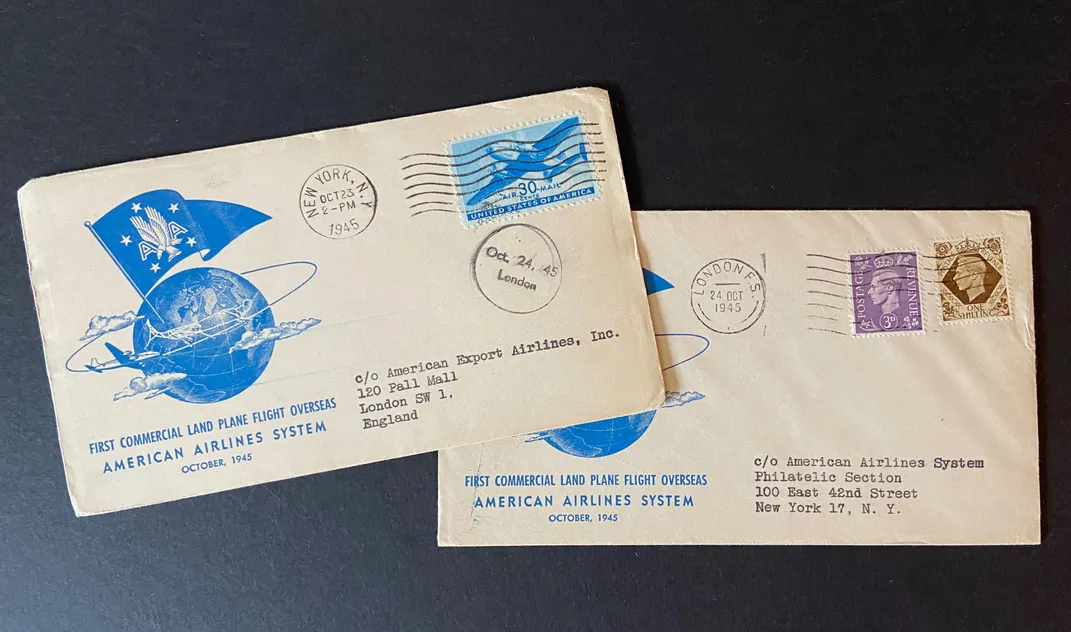
The Second Assistant Postmaster was flying to London for the day to oversee the postmarking of the thousands of beginning-flight covers packed into the DC-4's agree, each envelope declaring that it had been carried on the "First Commercial Land Plane Flying Overseas." And and so it was straight home side by side day on the render flying, carrying a second ready of covers with British stamps. Philatelists were thrilled.
Stamp collectors might have considered October 23, 1945 a day to remember, but 75 years subsequently few recall the first scheduled transatlantic service via "state aeroplane" from New York to London—or at least to Bournemouth, a seaside town 100 miles from the British capital. (London's Heathrow didn't open up to transatlantic flights until May 1946.) Everyone who has ever flown the Atlantic in economy form should have been invited to a large 75th anniversary party—except at that place was no party. It wasn't cancelled because of COVID. Information technology was never planned.
So allow us raise a glass to that late Tuesday afternoon long ago when a DC-4 named Flagship London and operated by a newly acquired American Airlines subsidiary, American Export Airlines (AMEX), went "wheels upwardly" from LaGuardia Airport. The commencement stop was Bedford Ground forces Air Field in Boston to pick upwardly Governor Tobin, along with radio personality and Boston Daily Earth columnist John Barry. So information technology was on to refueling stops in Gander, Newfoundland and Shannon in the Democracy of Ireland earlier the final hop to Hurn, the airfield at Bournemouth.
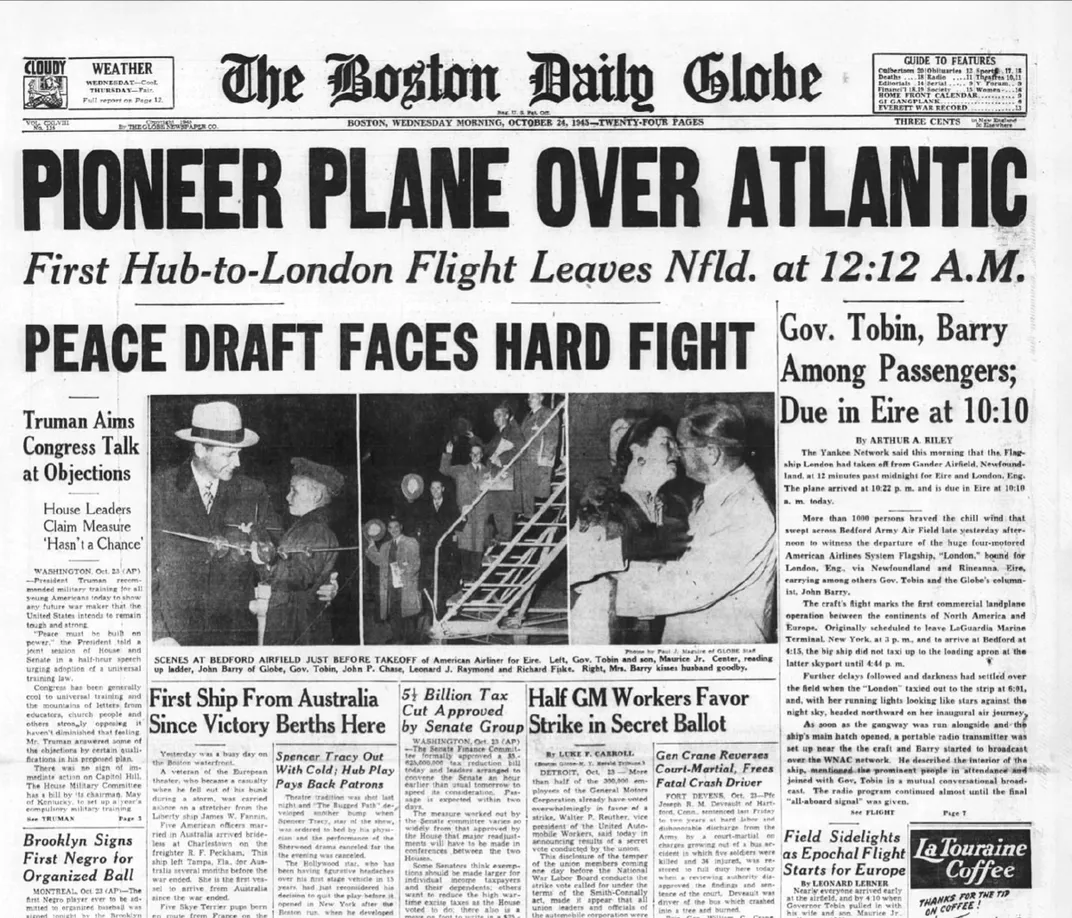
For Barry, information technology was all as well much—or maybe too little. His front-page story began: "HURN AIRFIELD, ENGLAND, Oct. 24—History will never believe it! Afterwards completing the first commercial flight of a landplane from North America to Europe late this afternoon, the American Airlines flagship 'London' came out of the heaven over this field, landed gently, came to a finish and a rider yawned. It was merely as commonplace as that."
A yawn on arrival is the standard salute of most passengers who cantankerous the ocean in today's landplanes. However that offset yawn marked the finish of the era of the flying boat, the glamorous "Clippers"—the Boeing 314 and the Sikorsky VS-44—that lofted a tiny number of the rich and important across the seas. That yawn signaled the start of airborne travel for the masses. From this apprehensive commencement of 12 passengers, transatlantic passenger traffic increased dramatically, with 312,000 passengers crossing by air in 1950. Henceforth silverish airliners would lift off from concrete runways, carrying business travelers and tourists first by the thousands and and then by the millions.
There are sound reasons why the celebration of the inaugural flight is so…muted. The year 1945 was a historic one, and the 2020 calendar for 75th anniversaries—VE Day, VJ Day, the U.Due north. Lease, and the atomic flop for starters—was already crowded.
More importantly, corporate identity left the event a brand orphan. The airline that might have been throwing the party—American Airlines—sold its Atlantic sectionalisation to Pan Am in 1950. When Pan Am went bankrupt in 1991, Delta inherited its transatlantic routes (but apparently little obligation to celebrate past glories).
Finally, the offset of country-based commercial flights to Europe was not a bold bound forward in 1945. It was the obvious next step. What had been daring in 1939 when Pan Am opened regular Northward Atlantic rider service with its Boeing 314 flight boats was former hat half dozen years later. By the end of the war, the DC-4—with its big reliable Pratt & Whitneys, shiny streamlined skin, capacious cabin, long-range fuel tanks, and tricycle landing gear—had made thousands of chartered Atlantic crossings equally C-54s, the U.S. Army version of the DC-4, and as U.S. Navy-designated R5Ds. In late 1945, the War Department began allocating war-surplus C-54s at bargain prices to the 3 rivals for the transatlantic market: Pan Am, American, and the upstart TWA. Pan Am announced the earliest start appointment—October 20—but first the airplanes had to be stripped of their spartan military machine interiors and converted into civilian-carrying airliners.
In the end, American's AMEX division was the showtime airline set, on the 23rd. (Pan Am wasn't ready until the 28th.) Aviation News reported that to promote the new service, AMEX had mounted a publicity stunt, "an aerial printing conference held over New York City in the offset DC-4 to be certificated for civilian transport use." Reporters and American Airlines top contumely circled Manhattan in the refurbished airplane, which had to be repainted a week later afterward American rebranded its AMEX division as American Overseas Airlines (AOS).
Forth with publicity agents and printing junkets, this was too the heyday of shoe-leather reporters with "printing" cards tucked in their fedora hatbands who haunted oceanliner docks and air terminals to take hold of returning and parting celebrities. "It seems every bit if during the past yr, I've interviewed every world grapheme except Hitler and Mussolini," said i veteran of a LaGuardia stakeout, "and I wouldn't be surprised to see them bear witness upward at any fourth dimension."
Hitler wasn't going anywhere by late 1945 but the wire services—United Press, Associated Press, Canadian Press, and Northward American Paper Alliance—sent reporters to encompass the offset trip to London. Their stories made front end-page news from Circleville, Ohio to Jacksonville, North Carolina. The Boston Daily Globe went with a banner headline: "PIONEER Plane OVER ATLANTIC."
The Washington Star devoted an entire folio of its Sunday edition to the implications of the flight. "A new era in trans-Atlantic air travel began tardily this month as U.s.a. air lines inaugurated a speedy low-priced service," proclaimed Joseph A. Baird. "It was the first pace toward a not-besides-distant future when a weekend jaunt to Europe will be inappreciably more expensive than a trip to the West Declension."
Low fares and weekend transatlantic jaunts have since proved elusive, but Baird was right. In 1945, the technology and the operating experience were finally in place.
The Globe's John Barry reported that the converted airliner was roomy: "They took two or three rows of seats out so we can walk effectually the plane. We could go upwardly on the flight deck. I didn't bother to go up at that place until 4 o'clock this morning, when the helm asked me to come upwardly. It was just naught up there. In that location was water ice on the wings. But this didn't seem to bother them inside. I would recommend anyone taking this transatlantic trip to purchase a pair of bunny slippers, because their anxiety will exist cold.
"Along almost 9 o'clock, I heard the weep that nosotros were landing," continued Barry. "Well, I rushed up to the flight deck, and at that place in the distance I could come across the green fields of Ireland." The Flagship London was refueling at Rineanna, the land-base twin of Foynes, the seaplane base across the Shannon River where the groovy flying boats had landed throughout the war. Foynes would wither within weeks as Pan Am and American apace shut down seaplane service to Europe.
"Then we went over the Shannon River, over Canton Clare, downwardly to the drome where nosotros got a royal greeting," wrote Barry. "The Governor was greeted by his cousin who came downward from his hometown virtually Cork. And what a human being. He is the greatest weightlifter in all Ireland and stands half dozen ft. half dozen in. He took the Governor abroad with him."
Wherever the giant cousin took him, Governor Tobin stayed on in Republic of ireland for a few days. The other passengers, including Barry, went on to London. Barry ended his reporting with: "I want to tell y'all folks that travel—transatlantic travel—is going to exist commonplace, a daily thing."
/https://tf-cmsv2-smithsonianmag-media.s3.amazonaws.com/filer/ac/2a/ac2ac6a5-de61-4d61-b4b1-944e00541490/13m_on2020_dc-4_photob_live.jpg)
After American Export Airlines vanished into the American Airlines portfolio, international flying blew a hole in the airline's bottom line. In 1950, American'south unsentimental boss, C.R. Smith, cut a handshake deal in the concourse of New York'due south Thousand Cardinal Station with Pan Am's Juan Trippe to hand over at a great loss its AOS transatlantic shipping, employees, and routes. "The smartest affair nosotros e'er did was to get the hell out," said Smith. American Airlines did not return to London service until 1991, when it bought out the Heathrow gates and assets of a failing TWA.
About the DC-4 that fabricated the historic transatlantic flying, there is a mystery. AMEX called all its big airplanes "flagships." All the newspaper accounts of the first flight agree that the aircraft was the Flagship London. The reporters didn't bother with tail numbers. Geza Szurovy's 2000 book Classic American Airlines credits that get-go flight to a DC-4 named Flagship New England, with tail number N90904. No Flagship London is mentioned. If the Flagship London was later renamed Flagship New England, then it came to a terrible end. In Oct 1946 on takeoff from an airfield at Stephenville, Newfoundland, Flagship New England N90904 plowed into a hillside, killing all 39 onboard.
If the first-flight DC-4 wasn't N90904, then information technology was sold out of the American Airlines armada with the other converted DC-4s as pressurized, high-distance DC-6s and Lockheed Constellations took over the transatlantic service. The ex-American DC-4s were passed downwards the chain of used shipping sales, finally disappearing from the Federal Aviation Administration'due south tail-number registry.
And so I remembered Second Banana Postmaster General Sullivan. I consulted eBay and quickly found a matched pair of Sullivan's first-flight covers with U.S. postage going east and Royal Mail stamps going west. The stamp on the back of the U.S. covers reads: "This is to certify this encompass was carried on the offset commercial flight from Boston (Bedford Airport), U.s.a., October 23rd, 1945 to London (Hurn Airport), England." The stamp doesn't identify the aircraft, but I got both covers for $viii plus shipping and handling. They will be the guests of honor—well, the just guests—at my First-Commercial-Flight-of-a-Landplane-from-Northward America-to-Europe 75th Anniversary Party. Oh, for a pair of bunny slippers.

When Did Regular Transatlantic Jet Aircraft Service Begin,
Source: https://www.smithsonianmag.com/air-space-magazine/forgotten-first-flight-180975833/
Posted by: conradforearephe.blogspot.com
0 Response to "When Did Regular Transatlantic Jet Aircraft Service Begin"
Post a Comment