

Which Service Below Does Not Put Log Information Into /var/log/maillog?ã¢â‚¬â€¹
Agreement Logging Levels: What They Are & How To Employ Them

Making sense out of logs is non an easy task. Log management solutions gather and have data from multiple sources. Those sources can accept unlike log events structures, providing a different granularity. They may not follow common logging all-time practices and exist hard to go some pregnant from.
Because of that, information technology is important to follow expert practices when we develop an application. One of those is keeping meaningful log levels. That allows a person who will read the logs and try to give them meaning to understand the importance of the bulletin that they encounter in the text files or i of those awesome observability tools out there.
What Is a Logging Level
A log level or log severity is a piece of information telling how of import a given log message is. It is a simple, even so very powerful way of distinguishing log events from each other. If the log levels are used properly in your awarding all you demand is to expect at the severity starting time. It will tell you if you tin can go along sleeping during the on-call night or you demand to jump out of bed correct away and hit another personal all-time in running betwixt your bedroom and laptop in the living room.
You can think of the log levels as a way to filter the critical information nearly your system state and the ane that is purely informative. The log levels can help in reducing the data dissonance and reduce alert fatigue.
The History of Log Levels
Before continuing with the description of the log levels themselves it would be skillful to know where the log levels come up from. It all started with syslog. In the 80s, the Sendmail a mailer daemon projection developed by Eric Allman required a logging solution. This is how Syslog was born. Information technology was speedily adopted by other applications in the Unix-like ecosystem and became a standard. Btw – at Sematext we exercise support Syslog format with Sematext Logs, our log management tool.
Syslog came with the idea of severity levels, which are now defined in the syslog standard. Syslog comes with the following severity levels:
- Emergency
- Warning
- Critical
- Error
- Warning
- Notice
- Informational
- Debug
Subsequently the 80s programming languages were evolving and different logging frameworks were introduced. Present each programming language has its own logging framework allowing you to save data in various formats similar JSON. In most cases you can transport information to dissimilar destinations like text file, syslog or Elasticsearch. But apart from the format and the possible destinations there is one matter that is mutual to the majority of them – the level of the log event.
Log Level Hierarchy: What Are the Most Common Logging Levels & How to Cull Them
In most logging frameworks you will encounter all or some of the post-obit log levels:
- TRACE
- DEBUG
- INFO
- WARN
- Fault
- FATAL
The names of some of those give yous a hint on what they are nearly. However, allow'due south discuss each of them in greater detail.
TRACE – the most fine-grained information only used in rare cases where you need the full visibility of what is happening in your application and inside the third-party libraries that you lot use. You tin expect the TRACE logging level to exist very verbose. You tin apply information technology for example to annotate each pace in the algorithm or each individual query with parameters in your lawmaking.
DEBUG – less granular compared to the TRACE level, but it is more than you will need in everyday employ. The DEBUG log level should exist used for information that may be needed for diagnosing problems and troubleshooting or when running application in the test environment for the purpose of making sure everything is running correctly
INFO – the standard log level indicating that something happened, the application entered a sure state, etc. For case, a controller of your authorization API may include an INFO log level with data on which user requested say-so if the authorization was successful or not. The information logged using the INFO log level should be purely informative and not looking into them on a regular ground shouldn't result in missing whatsoever important information.
WARN – the log level that indicates that something unexpected happened in the application, a problem, or a situation that might disturb one of the processes. But that doesn't hateful that the awarding failed. The WARN level should be used in situations that are unexpected, but the code can continue the piece of work. For example, a parsing error occurred that resulted in a sure document not being candy.
ERROR – the log level that should be used when the awarding hits an effect preventing one or more functionalities from properly operation. The Error log level can be used when one of the payment systems is not available, but at that place is still the option to cheque out the basket in the due east-commerce awarding or when your social media logging option is non working for some reason.
FATAL – the log level that tells that the awarding encountered an outcome or entered a state in which one of the crucial business functionality is no longer working. A FATAL log level may be used when the application is not able to connect to a crucial information store like a database or all the payment systems are non bachelor and users tin't checkout their baskets in your e-commerce.
To summarize what we know near each of the logging level:
| Log Level | Importance |
|---|---|
| Fatal | One or more key business functionalities are not working and the whole organisation doesn't fulfill the concern functionalities. |
| Mistake | 1 or more functionalities are not working, preventing some functionalities from working correctly. |
| Warn | Unexpected behavior happened inside the awarding, just it is continuing its work and the key business concern features are operating every bit expected. |
| Info | An event happened, the issue is purely informative and can be ignored during normal operations. |
| Debug | A log level used for events considered to be useful during software debugging when more granular information is needed. |
| Trace | A log level describing events showing step by pace execution of your code that can be ignored during the standard performance, but may exist useful during extended debugging sessions. |
Making Sense of Log Levels
The adjacent question that you are probably already asking in your heed is how to make sense of log levels in your log events. There are two main things that you can think of, especially when using a log analysis solution like Sematext Logs.
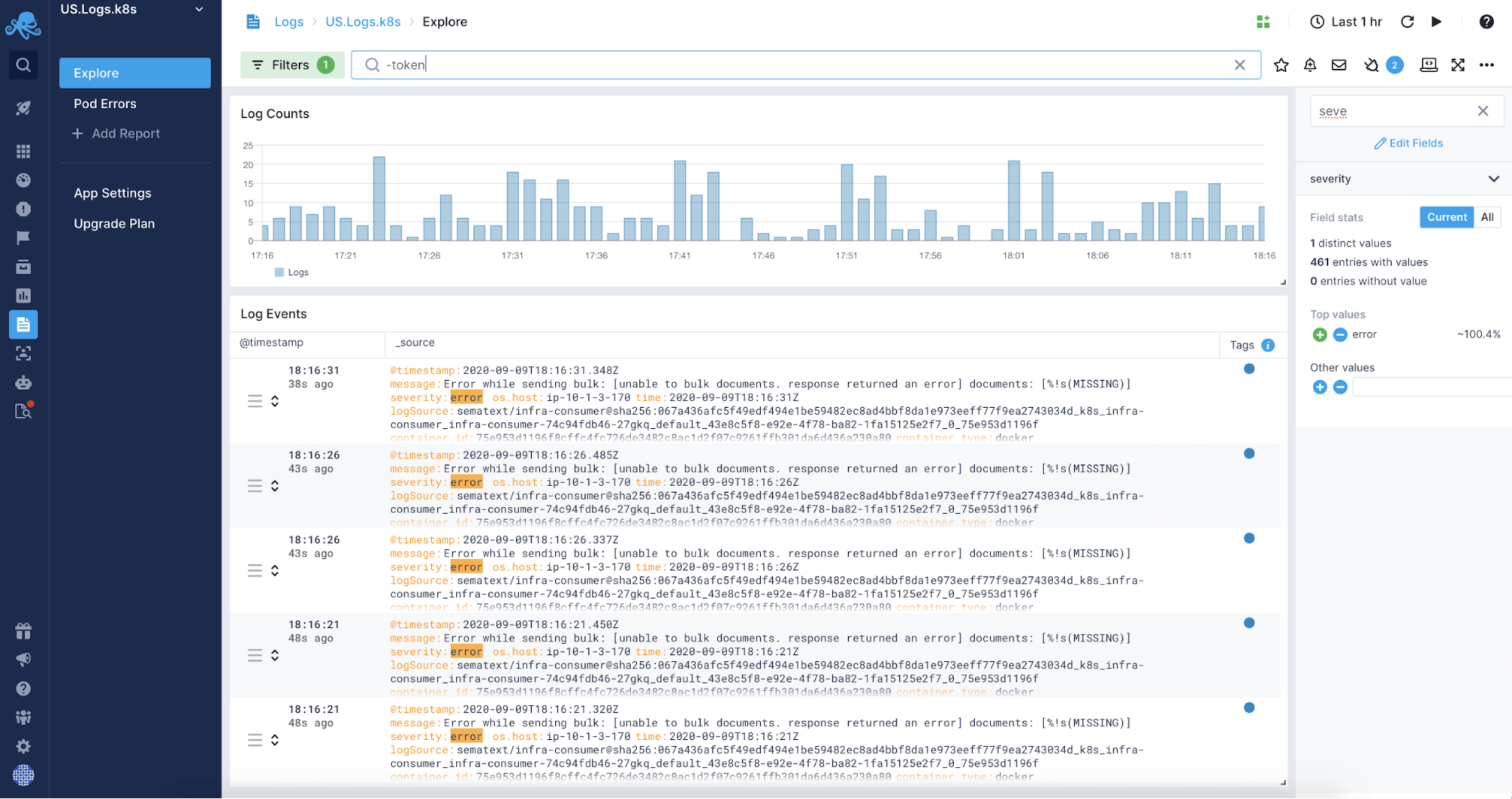
Kickoff of all – filtering. Y'all can filter your logs to only prove the ones having a given log level. For case, internally in Sematext, nosotros use the severity proper name. Yes, nosotros do like syslog and in fact, we even support syslog format when shipping logs to Sematext Cloud, our deject monitoring tool. And so, when I need to expect for errors in our logs I can easily do that past using filters:
The 2nd thing is the alerting functionality. Alerting is a very powerful tool, just can be overwhelming. Alerts should be actionable. That means that an alert should be an alarm if someone needs to take an activeness on it by doing something. For instance, remove files from a device to avoid hit 100% of disk utilization.
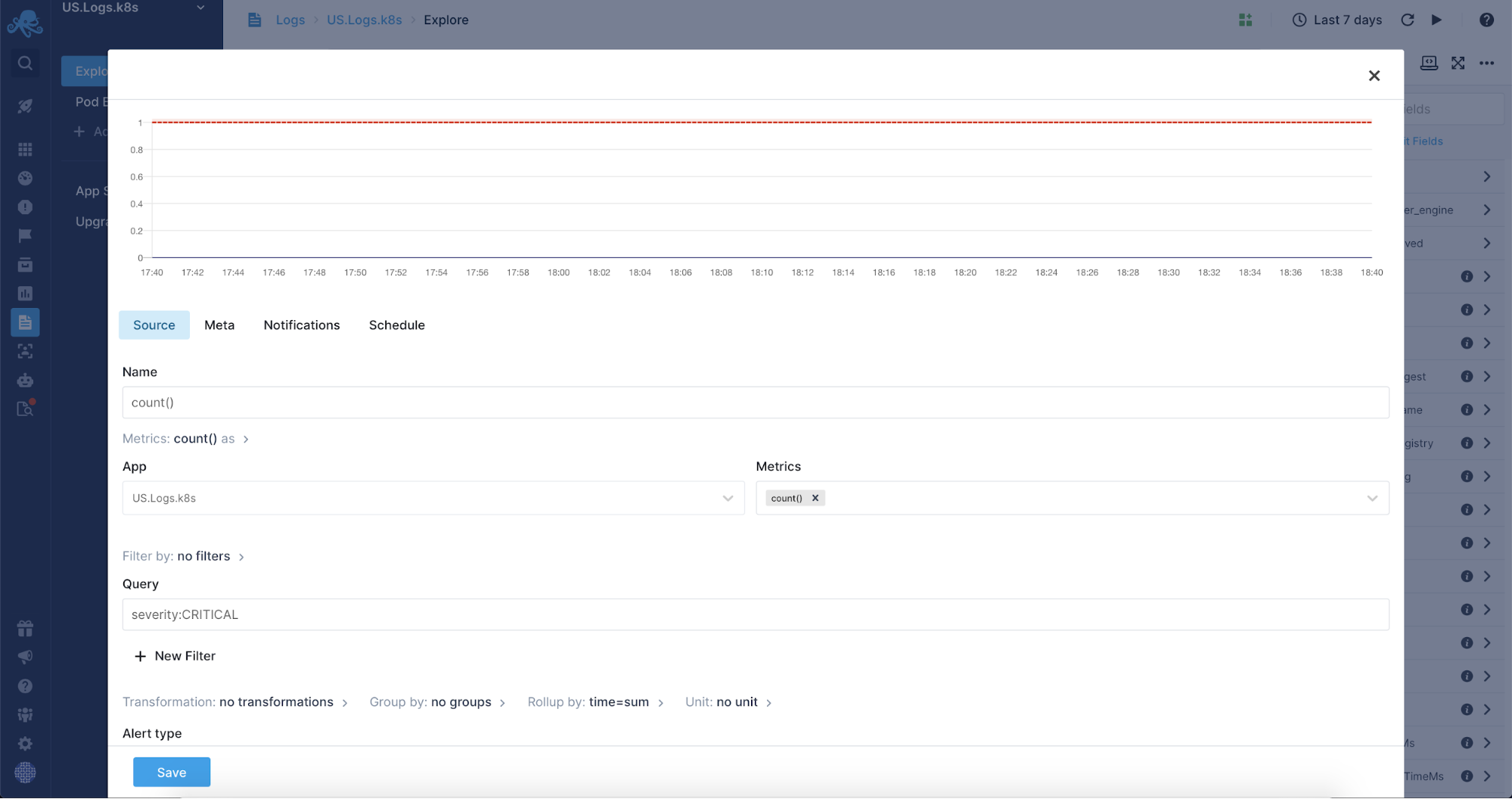
If your awarding logs utilize the log levels well you can create alerts on all CRITICAL log level letters. Every bit we already mentioned, the CRITICAL log level means that the crucial part of the application is not working and we are not delivering a business logic, so a total failure. You tin potentially create alerts on Error log level messages too, but that highly depends on the functionality. For example, in Sematext Cloud, nosotros tin can easily create an alert for any log event that will have a CRITICAL log level:
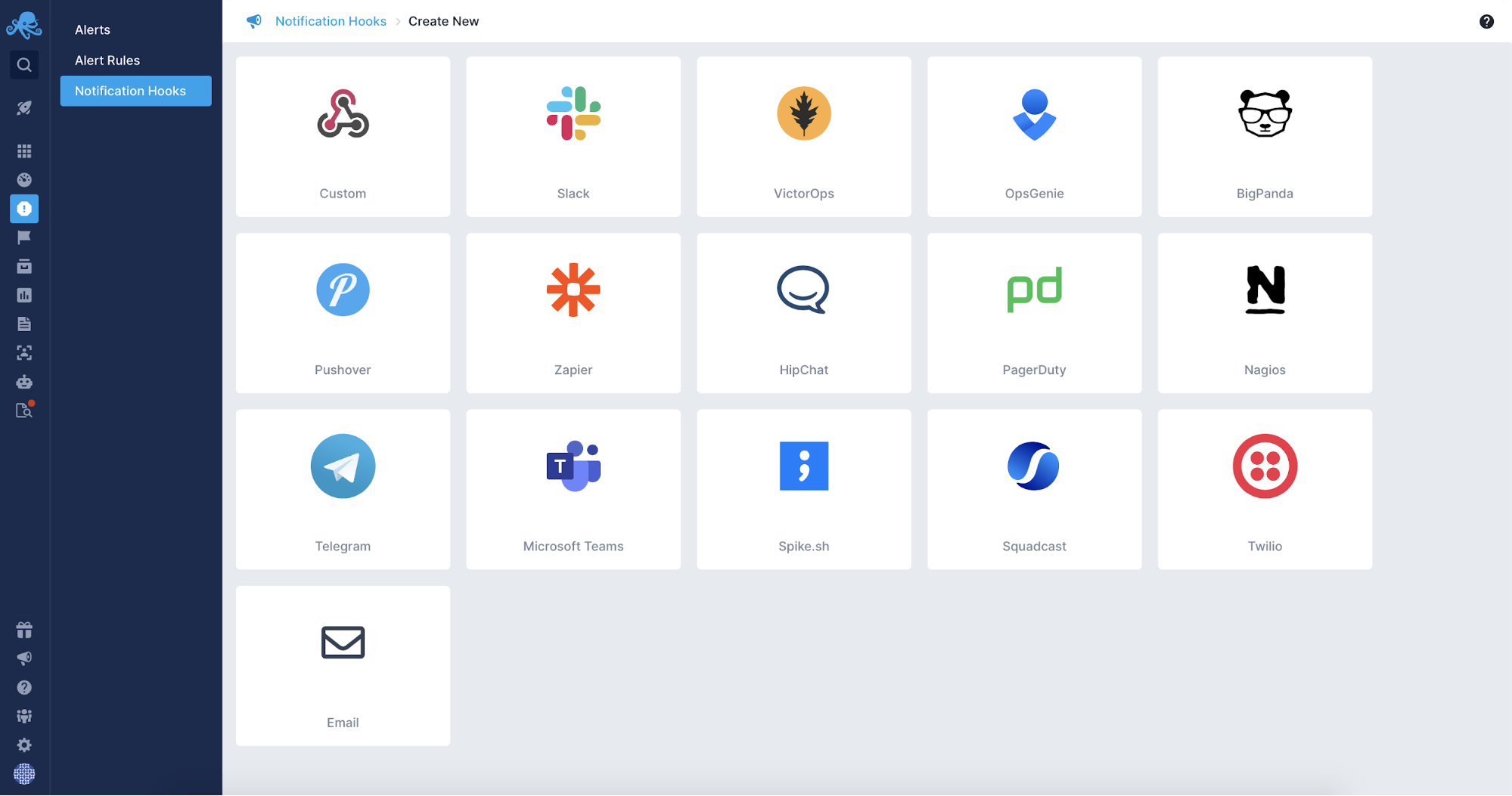
What's more, we tin can easily connect various notification hooks to such an alarm to exist notified using our preferred software:
But keep in heed – use the log levels wisely. Giving a Disquisitional log level to a WARN level log event will consequence in an alert and notifications to people who are on call. If the situation was not close to being critical shortly your alerts will start existence ignored, which is simply a step abroad from ignoring real CRITICAL situations and having the organisation in a non-working state for hours.
How Do Log Levels Work
Well, on their own they don't piece of work at all. They are labels that serve an informational purpose. They are in that location, in the log message, to provide information. The log levels say how important a given event is. Should yous bound out of your cozy bed right abroad to fight with a critical issue, or possibly you lot can just leave it till morning and the globe volition not cease for a few hours in one case the patch is prepare and deployed.
When combined with a logging framework you tin can hands limit the information that is written to the log destination of your choice. When setting the log level that you are interested in your logging framework you finer limit all less important log levels to exist ignored. So if you set your logging framework to have the root logging level to WARN y'all will only become log events with WARN, Error, and FATAL levels:

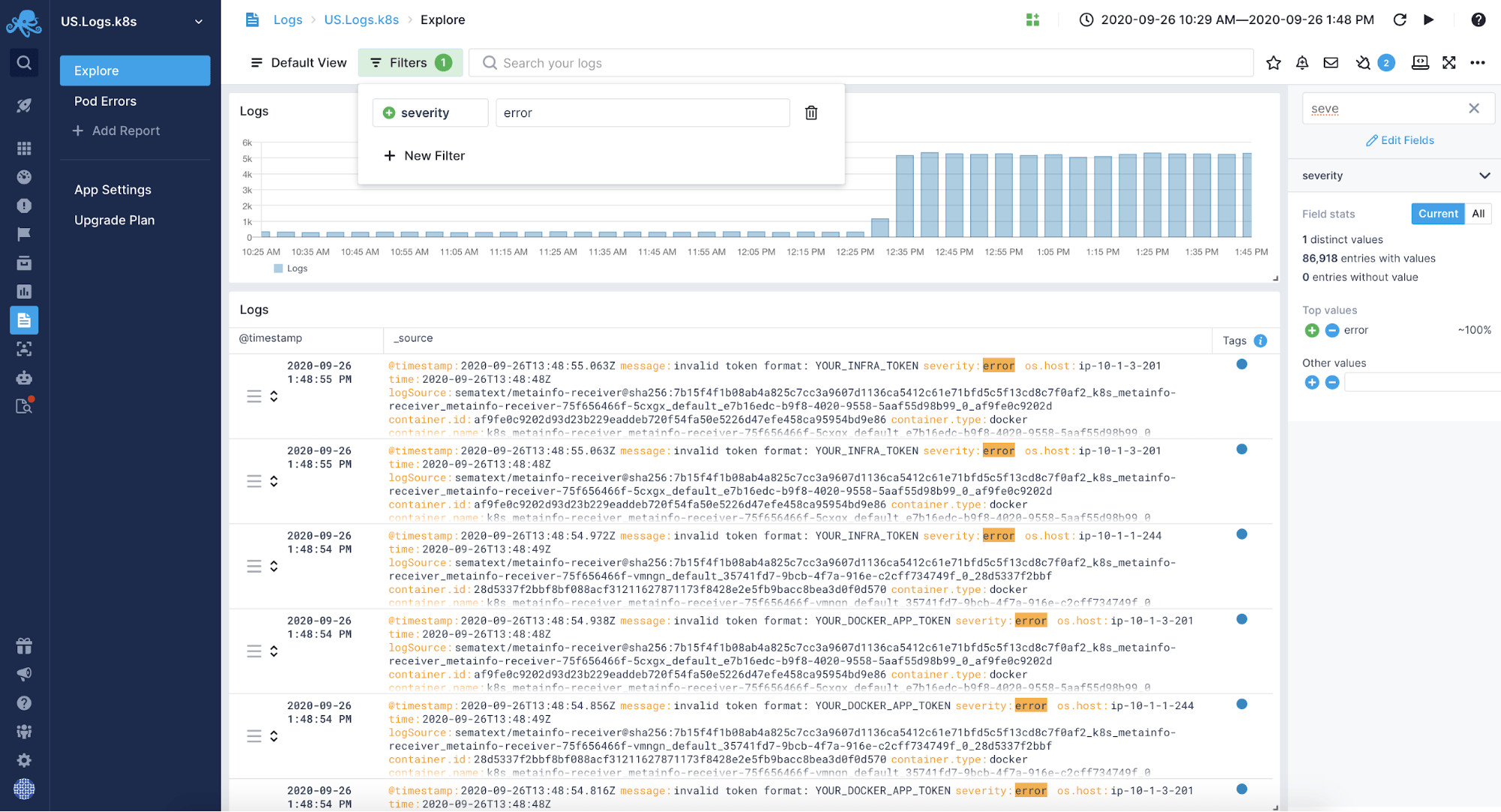
When combined with a log analysis solution your log level can play an data function simply also work as a filter finer limiting the data that you are looking for:
Decision
Choosing the right log level when developing an application is crucial. It may not exist visible while coding, but for certain it will be beneficial for everyone who uses logs when looking for issues, troubleshooting, creating alerts, or just looking into them regularly. The ease of filtering, alerting, and finding the right information easily is extremely important when dealing with a growing book of log messages that nowadays systems produce. Although products like Sematext Logs help you deal with that, we also demand to think about what we ship to them. As they say – garbage in, garbage out. Keep that in mind and make your logs useful for efficient log direction. As we take only discussed, 1 of the key steps to that is using proper log levels – skilful luck!
If you lot're working with Java applications, you tin can learn nigh the logging levels available from our beginner'south guides:
- Coffee Logging
- Log4j Tutorial
- Logback Tutorial
- Log4j2 Tutorial
- SLF4J Tutorial
Already looking for a logging solution to help you make the nigh of your logs? We have just the blog posts for you lot. We wrote in-depth reviews of all the solutions in the log management landscape, from log management software and assay tools to log aggregation tools, and deject logging services.

Source: https://sematext.com/blog/logging-levels/
Posted by: conradforearephe.blogspot.com
0 Response to "Which Service Below Does Not Put Log Information Into /var/log/maillog?ã¢â‚¬â€¹"
Post a Comment